
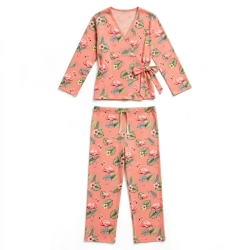
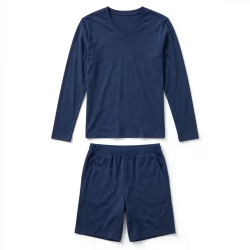
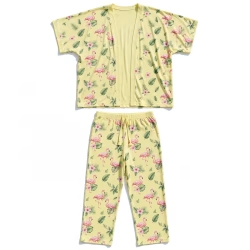
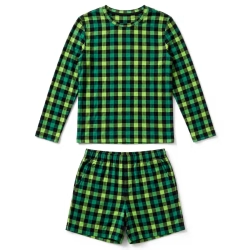
Siatex Apparel – A Custom Three-Piece Pyjama Set Manufacturer Bangladesh
For a garment brand, importer, wholesaler, retail chain, sourcing agent, or stockist, choosing the right Custom Three-Piece Pyjama Set Manufacturer Bangladesh can affect much more than the purchase price. Fabric consistency, fit, construction, branding, packaging, sampling, quality control, and the manufacturer’s ability to follow an approved specification all influence whether a sleepwear product is commercially ready.
Siatex Apparel positions its apparel manufacturing service around made-to-order and private-label production for international apparel buyers. Its product sitemap includes a dedicated three-piece pyjama set category alongside button-up, classic, two-piece, lounge, printed, short, long, and other sleepwear formats.
This guide explains what buyers should look for in a three-piece pyjama supplier, how customization works, what information to provide for sampling and costing, and how Siatex Apparel fits into the sourcing process.
What Is a Custom Three-Piece Pyjama Set Manufacturer in Bangladesh?
A Custom Three-Piece Pyjama Set Manufacturer Bangladesh produces a coordinated sleepwear set according to a buyer’s own product specifications rather than supplying only a fixed, ready-made design.
The three-piece format can be developed around the buyer’s intended construction. Depending on the product brief, a set may combine a pyjama top and matching bottom with an additional coordinated piece such as a robe, sleep shirt, camisole, shorts, or another approved component.
The important point for commercial buyers is that “three-piece” describes the product structure, while “custom” describes how the product is developed.
A private-label buyer may specify:
- Fabric composition and fabric weight
- Top and bottom measurements
- Third-piece design
- Sleeve and trouser length
- Collar or neckline
- Waistband construction
- Pockets and trims
- Colours and prints
- Buttons, piping, or other details
- Brand labels and care labels
- Hangtags and packaging
- Size range and grading
- Artwork and decoration
- Testing and compliance requirements
Siatex’s related pyjama manufacturing pages describe a development approach in which buyers can provide technical packs, sketches, reference garments, measurement charts, artwork, and fabric requirements as the starting point for product development.
For buyers comparing suppliers, this distinction matters. A manufacturer that can work from your specification gives you more control over the finished product than a supplier offering only standard stock designs.
Why Does a Custom Three-Piece Pyjama Set Manufacturer Bangladesh Matter?
Sleepwear can appear simple, but a three-piece set introduces several variables that need to work together.
The three garments must look like one coordinated product. Fabric shade, print scale, measurements, trims, labels, and finishing should remain consistent across the complete set.
For a retailer, that consistency affects presentation. For a wholesaler, it affects repeatability. For a private-label brand, it affects whether the product actually looks like the brand’s own collection.
Siatex’s classic and button-up pyjama manufacturing pages highlight the importance of controlling fabric, measurements, construction, colours, trims, branding, packaging, and sample approval before bulk manufacturing.
A three-piece program therefore needs to be assessed as a complete product rather than as three unrelated garments.
Better control over product positioning
The same basic sleepwear concept can be developed for different retail positions.
A value-oriented range may focus on straightforward construction and commercially practical fabrics. A premium private-label collection may put more emphasis on softer materials, detailed trims, custom artwork, branded packaging, and more distinctive silhouettes.
The manufacturer needs to understand the target customer and intended price position before finalizing the specification.
Easier brand differentiation
A standard pyjama set can look similar to competing products. Custom development creates more opportunities to distinguish the collection through colour, print, fit, trims, branding, and packaging.
Siatex lists options such as woven labels, printed care labels, hangtags, embroidery, screen printing, heat-transfer branding, custom packaging, and carton markings among the customization possibilities described on its related pyjama pages.
What Should Buyers Customize in a Three-Piece Pyjama Set?
The best results usually come from defining the product before asking for a final quotation.
1. Fabric
Fabric affects comfort, appearance, weight, drape, durability, washing behaviour, and cost.
Siatex’s related pyjama pages identify cotton, combed cotton, organic cotton, cotton blends, modal blends, bamboo viscose blends, elastane blends, and recycled polyester among possible fabric constructions, subject to the product specification.
The right choice depends on the intended market.
For example, a lightweight sleepwear collection for a warmer climate may require a different fabric weight from a winter collection intended for Canada or northern Europe. Fabric selection should also be considered alongside printing, shrinkage, colour requirements, and the desired retail price.
2. The three-piece configuration
Do not simply specify “three-piece pyjama set.”
Define exactly what the three components are.
For example:
- Long-sleeve top + trousers + robe
- Camisole + trousers + robe
- Short-sleeve top + trousers + shorts
- Sleep shirt + trousers + matching outer layer
The precise configuration affects fabric consumption, construction, sampling, packaging, and costing.
3. Fit and measurements
A manufacturer needs clear measurements to create a repeatable product.
Useful specifications may include:
- Chest
- Shoulder width
- Body length
- Sleeve length
- Waist
- Hip
- Rise
- Inseam
- Trouser length
- Leg opening
- Third-piece measurements
An approved size chart should become the reference point for pattern development and bulk production. Siatex’s classic pyjama manufacturing information specifically describes pattern development around buyer-approved measurements and size charts.
4. Colours, prints and patterns
The visual identity of the set can be changed through solid colours, stripes, checks, plaids, florals, graphics, repeating motifs, or seasonal artwork.
For printed programs, buyers should provide artwork files, placement instructions, colour references, and any applicable production standards.
Siatex’s sitemap also lists a dedicated custom printed pyjama set category for buyers developing printed sleepwear collections.
5. Branding and packaging
For private-label sleepwear, branding should be planned at the same time as garment development.
The specification can cover:
- Main brand label
- Size label
- Care label
- Hangtag
- Logo application
- Packaging
- Barcode information
- Polybags
- Carton markings
This is particularly important for retail chains and established brands that need the finished product to match an existing packaging and labelling system.
How the Custom Pyjama Manufacturing Process Works
A clear development process reduces ambiguity between the buyer and factory.
Step 1: Send the product brief
Start with whatever information is available.
A complete technical pack is ideal, but a buyer can also begin with a sketch, reference garment, measurement chart, fabric requirement, artwork, or product photographs.
The more specific the initial brief, the easier it is for the manufacturer to understand the intended product.
Step 2: Review construction and materials
The manufacturer reviews the garment construction, fabric, measurements, trims, colourways, artwork, labels, packaging, quantity, and other requirements.
For a three-piece set, this stage should confirm all three components rather than focusing only on the primary top and trouser.
Step 3: Develop the pattern and sample
Pattern development translates the approved measurements and construction into physical garment components.
A sample then gives the buyer an opportunity to assess:
- Overall fit
- Fabric hand feel
- Measurements
- Garment proportions
- Construction
- Print or embroidery
- Trims
- Branding
- Finishing
Siatex’s related pyjama pages describe sample development before bulk production and emphasize reviewing construction and specifications before production approval.
Step 4: Approve the specification
Comments from the sample should be recorded clearly.
Instead of saying “make it looser,” specify which measurement needs to change and by how much.
The same principle applies to sleeve length, trouser length, neckline, pocket placement, print position, waistband construction, and third-piece dimensions.
Step 5: Move into bulk production
Once the product specification is approved, production can be organized around the agreed materials and construction.
The broader Siatex custom apparel manufacturing service describes a workflow covering product development, material sourcing, production management, quality inspection, and export coordination. Siatex Apparel
Step 6: Inspect finished goods
Quality control should compare production against the approved specification.
Relevant checks can include fabric quality, shade, measurements, stitching, seams, trims, print placement, branding, finishing, and packing accuracy.
Siatex’s related pyjama manufacturing pages describe both production-stage and final quality checks.
What Fabric Should You Choose?
There is no universal “best” fabric for a three-piece pyjama set.
The correct choice depends on the customer, season, climate, design, target price, and performance requirements.
Cotton can be suitable for familiar everyday sleepwear. Modal or viscose-based options can be considered where a softer, more fluid feel is required. Blended fabrics may be useful when buyers need a particular balance of performance, durability, stretch, or cost.
The important sourcing principle is to specify the fabric rather than leaving it as an open-ended decision.
A buyer’s specification can include fibre composition, fabric weight, construction, colour, finishing requirements, and applicable performance or testing standards.
For complementary homewear products, buyers can also compare the custom lounge pants manufacturing option when planning a wider collection.
Three-Piece Pyjamas for Different Buyer Types
A good supplier should be able to understand why different commercial buyers need different specifications.
Garment brands
A fashion or sleepwear brand may prioritize distinctive design, custom prints, brand identity, fit, and packaging.
The manufacturing brief should reflect the brand’s existing product standards so the pyjama set looks consistent with the rest of the collection.
Importers
Importers often need a commercially scalable product with clear specifications, predictable quality, and packaging suitable for their distribution channel.
A detailed product brief can make supplier comparison easier because each manufacturer is quoting against the same requirements.
Wholesalers and stockists
Wholesalers may prioritize repeatable core styles, multiple colourways, commercial sizes, and packaging suitable for redistribution.
A three-piece set can also become part of a broader sleepwear assortment rather than a standalone product.
Retail chains
Retail sourcing teams generally need greater specification consistency.
Measurements, colours, labels, packaging, and quality requirements may need to remain aligned across seasonal orders and multiple stores or channels.
Sourcing agents
Sourcing agents can use the approved technical specification to coordinate development, sampling, materials, branding, production, inspection, and shipping requirements for their clients.
How to Compare Siatex With Other Bangladesh Manufacturers
Do not compare factories using unit price alone.
A lower initial quotation can become less attractive if the supplier cannot follow your measurements, fabric requirements, branding, packaging, or quality standards.
When comparing a Custom Three-Piece Pyjama Set Manufacturer Bangladesh, ask each supplier:
- Can you manufacture all three components as one coordinated set?
- Can you work from our technical pack or reference sample?
- What fabric compositions and weights can you source?
- Can you develop samples before bulk production?
- Can you apply private-label branding and packaging?
- How are measurements checked during production?
- What quality-control stages are included?
- What testing or compliance requirements can be incorporated?
- How will colour and print approvals be handled?
- What information do you need before providing a quotation?
These questions produce a much more useful comparison than asking, “What is your price per set?”
Siatex states that its garment manufacturing service works with international buyers and that its stated certification and audit framework includes ISO 9001, WRAP, BSCI, and SEDEX, with OEKO-TEX-certified fabrics available according to product requirements. Buyers should still confirm the specific certification, audit, testing, and compliance requirements applicable to their order before production.
Common Mistakes Buyers Should Avoid
Choosing a factory before defining the product
A supplier cannot accurately quote an undefined garment.
At minimum, provide the set configuration, fabric direction, size range, colours, quantity, branding requirements, and intended construction.
Treating the three-piece set as one garment
Each component has its own measurements and construction requirements.
All three should be included in the technical specification and sample approval.
Leaving fabric weight unspecified
“100% cotton” alone does not completely describe a fabric requirement.
Fabric weight, construction, finishing, colour, and performance expectations may all affect the finished product.
Skipping sample approval
A sample provides an opportunity to identify fit, construction, fabric, artwork, and branding issues before bulk manufacturing.
Do not treat sampling as an unnecessary delay when product consistency matters.
Giving vague revision comments
Specific comments are easier for a manufacturer to implement.
Instead of “the trousers are too big,” provide the relevant measurement and required adjustment.
Discussing compliance too late
Testing, labelling, restricted-substance requirements, packaging rules, and customer-specific standards should be discussed before production.
Siatex’s related manufacturing pages specifically advise buyers to provide applicable testing and compliance requirements as part of the product specification.
A Practical Buyer Brief for a Three-Piece Pyjama Set
Before contacting Siatex or another manufacturer, prepare a simple sourcing brief containing:
- Product name
- Three-piece configuration
- Target customer
- Reference images or technical drawing
- Fabric composition
- Fabric weight or GSM
- Colourways
- Print or artwork requirements
- Size range
- Measurement chart
- Measurement tolerances
- Trim requirements
- Branding requirements
- Packaging requirements
- Quantity by colour and size
- Target delivery schedule
- Destination market
- Testing and compliance requirements
This information gives the merchandising team something concrete to assess.
Siatex’s related classic pyjama manufacturing page similarly recommends providing product design or reference information, fabric requirements, size range, colourways, quantity, artwork, branding, packaging, delivery requirements, and applicable testing standards when requesting costing. Siatex Apparel
Related Sleepwear Manufacturing Options
A three-piece pyjama set does not have to exist as an isolated product.
Brands building a broader sleepwear collection can consider related formats based on their customer and merchandising strategy.
Siatex’s sitemap includes dedicated pages for custom button-up pyjama sets, custom classic pyjama sets, pants pyjama sets, printed pyjama sets, lounge sets, short and long pyjama sets, and other sleepwear categories.
This broader product approach can be useful when a retailer wants several sleepwear silhouettes under one brand. Common specifications such as colour standards, labels, packaging, and fabric direction can potentially be coordinated across the range.
For brands extending beyond sleepwear, Siatex also offers broader custom apparel manufacturing in Bangladesh, covering made-to-order apparel development for international buyers. Siatex Apparel
Frequently Asked Questions
What is Siatex Apparel – A Custom Three-Piece Pyjama Set Manufacturer Bangladesh?
Siatex Apparel is presented on its website as a garment manufacturer serving international apparel buyers, with a product sitemap that includes custom three-piece pyjama sets and related sleepwear categories. Its related pyjama manufacturing services focus on buyer-specific fabrics, measurements, construction, branding, packaging, sampling, and production. Siatex Apparel+2
Why does a Custom Three-Piece Pyjama Set Manufacturer Bangladesh matter?
The right manufacturer can give commercial buyers greater control over the finished product, including fabric, fit, three-piece configuration, colours, trims, branding, packaging, and quality requirements. This is particularly relevant for private-label brands, retailers, wholesalers, importers, and sourcing agents.
How do I get better results with this approach?
Start with a clear product specification. Define all three garments, measurements, fabric, colours, artwork, labels, packaging, quantity, and compliance requirements. Then review a physical sample before approving bulk production.
What mistakes should I avoid?
Avoid vague specifications, undefined fabric requirements, incomplete size charts, unclear branding instructions, and skipping sample approval. Also avoid comparing suppliers only on quoted unit price.
What should I do next?
Prepare your product brief and send the design, reference sample or technical pack, fabric preference, size range, colourways, quantity, branding requirements, packaging instructions, and destination-market requirements to the Siatex Apparel merchandising team.
Next Step: Request a Custom Three-Piece Pyjama Set Quote
If you are sourcing a three-piece pyjama collection for a garment brand, importing business, wholesale operation, retail chain, sourcing agency, or stockist program, the most useful next step is to give the manufacturer a complete product brief.
Siatex Apparel’s related custom pyjama manufacturing pages indicate that buyers can begin development with a technical pack, reference garment, sketch, measurement chart, artwork, or other product information, followed by sample development and production based on the approved specification.
For the strongest quotation, send:
- Your three-piece set design
- Fabric composition and preferred weight
- Size chart
- Colourways
- Artwork or prints
- Branding requirements
- Packaging requirements
- Quantity by colour and size
- Delivery requirements
- Applicable testing or compliance standards
The objective should not simply be to find the cheapest Custom Three-Piece Pyjama Set Manufacturer Bangladesh. It is to find a manufacturing partner that can translate your product specification into a consistent, retail-ready sleepwear set and repeat that standard at commercial scale.